
As car enthusiasts, we often like to sort things into finite but recognizable boxes. Wagon. SUV. Crossover. Sports car. Appliance. Labels make the world easier to understand, but they don’t always paint the full picture. Intent, more than classification, is what ultimately shapes how something feels. You can’t fully understand what a vehicle is, or what it means, until you discover what it encourages you to do with it.
The 2026 Toyota bZ Woodland lives in that in-between space. Toyota doesn’t call it a station wagon, and technically speaking, it isn’t one. It isn’t derived from a sedan, and it rides taller than long-roofs ever did in their heyday. But spend a full day driving one on pavement, then on harsher terrain, and it suddenly becomes clear that the Woodland isn’t chasing a category so much as it aims towards something specific. It’s an electric utility vehicle that feels driven towards a singular goal, rather than one which feels overly all-encapsulating to the point of monotony.

Cole Attisha
A Shape Guided by Use, Not Nostalgia
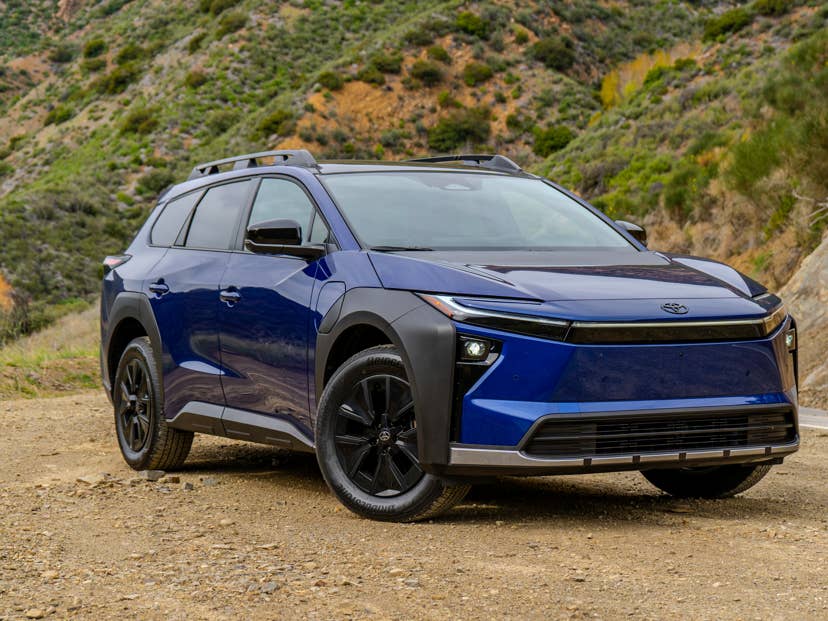
Visually, the bZ Woodland is a subtle but meaningful evolution of Toyota’s existing bZ design language. It’s nearly six inches longer than the standard bZ, slightly taller at the rear, and more visually restrained. It’s less concept-car futurism like you might find from other brands, and more inconspicuous confidence. Its proportions stretch just enough to convey a “family-friendly” orientation rather than sporty aggression, while standard roof rails and a longer cargo area reinforce its utilitarian focus. With 74.9 cubic feet of cargo space with the second row folded, the Woodland offers real, usable volume—more than the standard bZ—and the kind of space that encourages weekend plans rather than inhibits them. It’s less about visual drama and more about how easily gear and people fit into the same space.
Dirty Car? Shop Chemical Guys Specials: Up To 40% Off
Disclaimer: If you buy something via one of our links, we may earn a commission.

Chemical Guys Basic Wash and Wax Kit: 28% Off
Get a high foam wash with Mr. Pink, then wax your ride the easy way with Butter Wet Wax.

Chemical Guys Exterior Starter Kit: 33% Off
Upgrade your wash routine with the Clean Exterior Starter Kit.


Chemical Guys Streak Free Glass Cleaner: Just $9.99
Ammonia-free formula is safe for all window tints.
That mindset extends underneath the sheetmetal. Built in Subaru’s Gunma factory in Japan, alongside the Subaru Trailseeker, the Woodland wears its all-terrain credentials with great pride. For Toyota, authenticity is at the core of its products, and for the bZ Woodland, its utilitarian fundamentals dictate that it must have the functions one would expect from its appearance. If it’s going to talk the adventure-ready talk, Toyota insists it must be able to walk the off-road walk—hence why it turned to Subaru’s expertise for this one. Standard AWD, X-MODE with Grip Control, and 8.4 inches of ground clearance give the Woodland legitimate all-conditions capability before you ever start talking about tires or suspension.

Cole Attisha
On the Road: Fast Enough to Change the Conversation
My on-road drive took place in a blue bZ Woodland riding on standard Bridgestone Turanza all-season tires, and it didn’t take long to recalibrate expectations. With 375 horsepower from a dual-motor AWD system, the Woodland is officially the most powerful Toyota EV to date, and it certainly feels it. Toyota claims a 0–60 mph time of 4.4 seconds, but the real highlight isn’t the number; it’s the delivery. Acceleration is immediate and confident, not violent or showy, even if it does have the capacity to snap your neck like a bendy straw. Despite its rapid launch, the bZ Woodland is never quick to break traction—its power is there for a quick response when necessary, not to encourage buffoonery. The Woodland doesn’t try to impress you with theatrics—it simply goes, quickly and cleanly, every time you ask it to.

Cole Attisha
What surprised me most was how composed it felt once the road stopped being straight. The battery’s placement under the floor gives the Woodland a low center of gravity (even more so than, say, a Boxer engine), and the suspension—MacPherson struts up front, multi-link in the rear—keeps body motions well controlled. Steering is accurate, if not especially talkative (for what it is—this isn’t a racing car by any means), and while understeer does appear when pushed hard, it arrives predictably, as a gentle reminder of mass rather than a sudden reprimand. This isn’t a racing car in disguise that’s trying to justify its practicality. It’s a genuinely functional utility vehicle that happens to be surprisingly enjoyable to drive—an increasingly rare distinction, especially among electric utility vehicles.
For readers of Road Ethos, an enthusiast-led, lifestyle-focused publication that values how a car feels as much as what it promises, that balance matters more than unexecuted statistics ever could. “Theory only gets you so far.”

Cole Attisha
Off the Road: Calm, Capable, and Honest About Its Limits
For the off-road bit of the day, I swapped into a white bZ Woodland equipped with optional Dunlop Grandtrek all-terrain tires, which reduce EPA-estimated range from 281 miles to 260 miles. It’s a trade-off, but one that feels fair given the added traction and confidence they provide. The route took us up mild-to-moderately challenging clay trails on a sprawling California ranch with panoramic coastal views—land once owned by Paul Walker. It wasn’t extreme terrain, but it was real-world challenging in a way far more extreme than most owners will actually encounter: loose surfaces, uneven grades, and long downhill sections that test composure rather than bravado.

Cole Attisha
Engage X-MODE with Grip Control, and the Woodland settles into a reassuring rhythm. Throttle inputs are smoothed, traction is carefully managed, and downhill sections are handled by a cruise-control-adjacent system that automatically maintains speed. That system is effective, but certainly not subtle—the ABS can be extremely loud, grabbing at the brakes in a way that prioritizes control over refinement. Still, what impressed me most wasn’t outright capability, but rather composure. The Woodland remained smooth and comfortable even when the ground turned unfriendly, never feeling stressed or out of its depth. It doesn’t pretend to be a hardcore off-roader, and that honesty works in its favour. The limits are laid out clearly, and the experience within them is calm and confidence-inspiring—perfect for when those long family road trip adventures hit their rough patches.


Cole Attisha
Charging, Range, and Everyday Reality
Power comes from a 74.7-kWh lithium-ion battery, with DC fast-charging capability up to 150 kW, enabling 10–80% charging in around 30 minutes under ideal conditions. An 11-kW onboard AC charger, battery pre-conditioning, and a North American Charging Standard (NACS) port make living with the Woodland easier than many earlier Toyota EVs. Regenerative braking is adjustable via steering-wheel paddles. While the strongest setting stops short of true one-pedal driving, it remains intuitive and easy to tailor to preference. The Woodland doesn’t demand that you reorganize your life, or how you would normally use a car, around it—and for many buyers, that will be its most appealing trait.

Cole Attisha
Pricing and Positioning: Confident, Rather Than Cautious
With a starting price of $45,300 before destination, the bZ Woodland isn’t chasing entry-level EV buyers. Instead, it positions itself as a complete, well-equipped electric utility vehicle from the outset. Standard AWD, class-leading power, real off-road hardware, and a long list of comfort-focused amenities make the pricing feel ambitious, but defensible. Toyota isn’t asking you to buy into a lifestyle fantasy here, although this would certainly fit the bill for buyers looking for that, too. It’s offering a thoughtfully engineered tool that happens to be electric—and that confidence shows in its price point.

Cole Attisha
Interior: Purposeful, Comfortable, and a Little Too Safe
Inside, the bZ Woodland closely follows Toyota’s current EV interior philosophy, for better and worse. The cabin is anchored by a 14-inch Toyota Audio Multimedia touchscreen with wireless Apple CarPlay and Android Auto, and everything about the layout prioritizes ease of use over visual daring. Materials feel durable and thoughtfully assembled. SofTex-trimmed upholstery, heated front seats and heated outboard rear seats, a heated steering wheel, dual wireless Qi chargers, and four USB-C ports all come standard. The Woodland Premium adds ventilated front seats, radiant front-seat heaters, a panoramic fixed-glass roof, a digital rearview mirror, and a crisp JBL nine-speaker audio system that can handle Bad Bunny or Kid Rock with equally high fidelity.

Cole Attisha

Cole Attisha

Cole Attisha
What the interior doesn’t do, necessarily speaking, is excite the senses. The design is minimalistic, conservative, and very Toyota. It won’t quicken pulses, but it also won’t age poorly or irritate you in the long run. It feels built for people who intend to keep their cars, not just cycle through them; it feels distinctlyToyota-esque in its utility-forward design.

Cole Attisha
My Honest Verdict: An EV Shaped by A Guided Principle
The 2026 Toyota bZ Woodland isn’t trying to resurrect the affordable family station wagon, nor is it interested in redefining adventure. Instead, it argues that utility vehicles (including electric ones) can still be shaped by intention rather than by trends. Yes, parts of it remain a bit boring. The design is safe, and the interior is conservative. But where it matters most—how it drives, how it moves, and how it handles the spaces between destinations—the Woodland delivers with sincerity and the appropriate level of restraint.
For drivers who want an electric vehicle that feels capable without cosplay, fast without spectacle, and useful without sacrificing functionality for vanity, the bZ Woodland makes a compelling case. And for readers of Road Ethos, where enthusiasm is measured not by cylinders but by connection, it stands as proof that an EV doesn’t have to be shouty or extreme to be worth caring about. Sometimes, meaning isn’t found in what something claims to be, but in how naturally it fits into your life. The bZ Woodland understands that—it understands what it means to be a Toyota—and that may be its most valuable feature of all.

About the author

Cole Attisha
Staff Writer, Autoblog