
Why Station Wagons Have All But Disappeared in America
Station wagons didn’t disappear from the American market overnight. They faded slowly into the background, edged out not by outright rejection but by the eventual, profitable rise of crossovers and SUVs that promised more “lifestyle” and greater mass-market appeal. What’s left in 2026 is not a category so much as a curation. This short list of vehicles only exists because someone, somewhere within each brand, still believes a long roof matters.
Every wagon you can still buy new in America this year occupies a very specific niche. None of them is cheap, very few are mainstream, and all were very clearly designed and developed by real, diehard car enthusiasts. These are wagons built either to preserve a frugal ideal—comfort, balance, restraint—or to challenge expectations entirely through high performance or electrification; each one makes a clear statement on its own terms. It’s a landscape that feels less like a department store and more like a boutique fashion house; a feeling I’ve often gravitated toward in my work at Road Ethos, a lifestyle-focused, enthusiast-operated automotive publication where the appeal of a vehicle is measured as much by feeling as function. What follows isn’t a eulogy (for now, thankfully), but it’s not quite a celebration either. It’s simply a clear look at what still remains.

Audi
Audi A6 Allroad ($73,100 MSRP)
The Audi A6 allroad reminds people what a traditional luxury wagon can still do when it isn’t trying too hard to cosplay as an SUV (ahem, take notes, Subaru). It’s essentially a long-roof A6 with a bit of extra ride height, standard Quattro all-wheel drive, and more than enough rugged capability to justify its name. Unlike performance wagons that exist merely to flex and conquer, the allroad’s purpose is far more utilitarian. Comfort, space, and year-round usability are wrapped in a body style that doesn’t surrender to crossover monotony.

Audi
This is the wagon for buyers who value restraint and understatement, who want refinement without drama and practicality without bulkiness. It appeals to people who remember when wagons were the default family cars rather than niche indulgences with turbocharged V8 engines, and who prefer long highway road trips and ski weekends to race tracks and golf courses. The A6 allroad is one of the last mainstream premium wagons in America, competing in the segment alongside its three-point-starred counterpart, the Mercedes-Benz E-Class All-Terrain, but its next-generation replacement is still expected to be revealed this year. Whether it’ll arrive in the U.S. is another question entirely, but we’re hopeful that it will.

Audi
Dirty Car? Shop Chemical Guys Specials: Up To 40% Off
Disclaimer: If you buy something via one of our links, we may earn a commission.

Chemical Guys Basic Wash and Wax Kit: 28% Off
Get a high foam wash with Mr. Pink, then wax your ride the easy way with Butter Wet Wax.

Chemical Guys Exterior Starter Kit: 33% Off
Upgrade your wash routine with the Clean Exterior Starter Kit.


Chemical Guys Streak Free Glass Cleaner: Just $9.99
Ammonia-free formula is safe for all window tints.
Audi RS6 Avant Performance ($130,700 MSRP)
The RS6 Avant is and has always been a distinctly German middle finger to the idea that practicality and excess can’t coexist. It’s a large luxury wagon powered by brutish performance, built less to achieve high-volume sales figures and more because Audi knows exactly who will buy it. Tough guys with fine taste, that is—just look at the RS6’s on-screen heritage. Whether it’s Tom Hardy desperately trying to salvage the Harrigan family’s stature as London’s top-dog crime family in Mobland, or whether it’s Daniel Craig desperately trying to salvage his own arse in Layer Cake, on-film drivers of the Audi RS6 have always been the well-dressed, highly-calculated men who aren’t averse to using a good bit of brute force to get their way. That’s precisely the persona the RS6 exemplifies to a tee.

Audi
The RS6 Avant is for buyers who want supercar performance without sacrificing real-world usability and who understand that owning an RS6 is as much a cultural statement as it is a fulfilling driving experience. It’s for enthusiasts who, in principle, refuse crossovers and SUVs, but still need room for real life. In the modern American market, the RS6 Avant isn’t just a wagon—it’s one of Audi’s final remaining halo cars, having taken the torch from the R8.

BMW
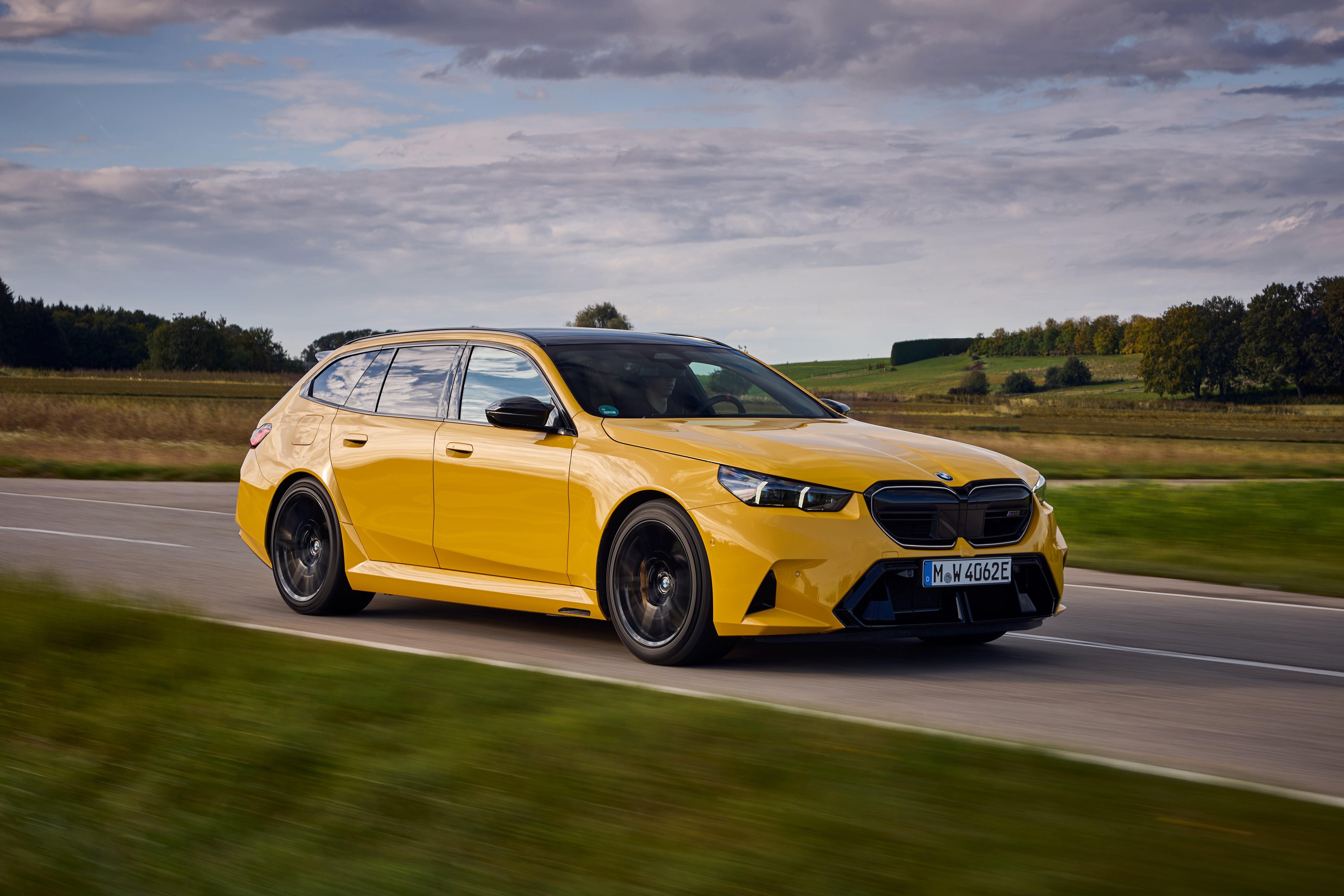
BMW M5 Touring ($125,300 MSRP)
The BMW M5 Touring represents something enthusiasts have been asking for—quite loudly—for decades: an M5 that doesn’t force you to choose between absurd performance and everyday usability. Globally, the M5 Tourings of the past have been the more complete expression of BMW’s super-sedan formula, pairing devastating pace with a long roof that actually makes sense for real life, although they’ve never before been made available for purchase in North America. Its return, even if it is drastically different from its predecessors, signals that BMW is finally willing to cater to its most dedicated audience rather than simply tease them, even if it comes at the expense of massive curb weight.

BMW
This wagon is for the enthusiast who refuses to separate “driver’s car” from “do-it-all vehicle.” Someone who wants M-level performance without surrendering cargo space, rear-seat practicality, or long-distance comfort. Under the hood, the latest M5 Touring pairs a twin-turbocharged 4.4-litre V8 with a plug-in hybrid system, producing over 700 horsepower, driving all four wheels, and delivering 0–60 mph performance in the mid-three-second range—numbers that would have sounded absurd for a wagon not all that long ago, especially one which weighs over 5,000 lbs. In a market that has largely abandoned wagons, the M5 Touring feels less like a mere product and more like a concession. It’s BMW acknowledging that passion still has a place in its lineup. If it continues to reach American buyers in meaningful numbers, it won’t just fill a niche; it will, in fact, validate one.

Mercedes-Benz
Mercedes-Benz E-Class All-Terrain ($78,300 MSRP)
The Mercedes-Benz E-Class wagon is the purest expression of what a luxury wagon used to be—and, perhaps, even the purest expression of what Mercedes-Benz used to be. It prioritizes ride comfort, refinement, and interior serenity above all else, offering a long-roof alternative for buyers who want luxury without visual aggression. There’s no performance posturing here, just a thoroughly polished vehicle designed to make daily life feel calmer and more peaceful. This is the hippy-beloved W123 Estate, modernized for a world where those hippies all had to grow up and get real jobs, but still never forgot what they stood for.

Mercedes-Benz
It’s for buyers who value comfort over clout, and who care more about how a car feels after three hours behind the wheel than how it looks sitting in a Whole Foods parking lot. Often overlooked in favour of SUVs, the E-Class wagon remains one of the most civilized ways to move people and cargo. Its continued existence feels almost defiant, even serving as an antithesis to modern Mercedes-Benz philosophy, and is deeply appreciated by those who still understand what it represents.

Mercedes-Benz
Mercedes-AMG E 53 HYBRID 4MATIC+ Estate ($93,350 MSRP)
The AMG E53 wagon is Mercedes’ attempt to bridge three worlds: traditional luxury, modern performance, and electrification. It blends AMG tuning with a hybrid straight-six powertrain, delivering strong, enthusiastic performance without sacrificing everyday efficiency. Unlike older AMG wagons that felt singularly focused, the E53 balances refinement and urgency in a way that feels deliberately multifaceted, although there’s still something to be said about the elephant in the room: the fact that a V8-powered, E63 Estate is, as of yet, nowhere to be found, leaving the sandbox for the Audi RS6 and the BMW M5 Touring to play in on their own.

Mercedes-Benz
This wagon is for buyers who want performance without the compromises that used to come with it. It suits someone who appreciates AMG’s engineering credibility but also wants quiet commuting, advanced tech, and a sense of future-proofing. In many ways, it represents the modern endpoint of the luxury performance wagon—fast, efficient, and unashamedly complex.

Porsche
Porsche Taycan Sport / Cross Turismo ($118,100-$224,300 MSRP)
The Porsche Taycan Sport Turismo and Cross Turismo represent the most modern interpretation of the station wagon. They’ve been shaped less by brand nostalgia and more by natural evolution. At their core, both build on the Taycan’s electric performance platform, extending it into a long-roof guise that genuinely enhances usability without diluting Porsche’s driving-oriented ethos. The Sport Turismo keeps things low, sleek, and performance-focused, while the Cross Turismo offers slightly higher ride height, subtle protective cladding, and broader versatility in the name of all-terrain capability. Neither pretends to be an SUV, and that distinction matters to enthusiast buyers.

Porsche
These wagons are for buyers who want to transition to the electric era without sacrificing their identity. Enthusiasts who still care about steering feel, chassis balance, and design coherence, but also want usable cargo space and daily functionality. In a market where wagons have either disappeared or turned into luxury superlatives, the Taycan’s long-roof variants feel radical. Not because they’re electric, but because they prove that performance wagons can still exist at the cutting edge of modern innovation. They don’t just keep the wagon alive; they aim to redefine what it can be.

Volvo
Volvo V60 Cross Country (limited availability) ($55,898 MSRP)
The Volvo V60 Cross Country now carries a weight it was never designed to bear: it is set to become the last station wagon Volvo will sell in America—and likely anywhere. That reality lends the V60 an added layer of significance, not because it suddenly changes what the car is, but because of what it represents. Volvo built its global reputation upon wagons that prioritized safety, durability, and understated competence long before those qualities became mere marketing slogans. The V60 Cross Country feels like the final expression of that old-world Volvo ethos.

Volvo
With its lifted stance, all-wheel drive, and restrained Scandinavian design, the V60 Cross Country was never about performance theatrics or luxury excess. It was about confidence in inclement weather, having a clear purpose, and the belief that a family car could be both sensible and desirable. For buyers who value balance over bravado—and who remember when Volvo’s wagons defined the entire segment—the V60 Cross Country feels not so much like a product cycle ending as it does the final chapter of your favourite book coming to a gratifying conclusion. Its disappearance doesn’t just mark the end of a model; it marks the end of a philosophy Volvo once embodied outright. My advice? Get one while you still can.

Subaru
What’s Missing (And Why)
Perhaps the most obvious absence here is the Subaru Outback, a vehicle that for many years served as America’s default wagon—even as it slowly drifted away from that identity. For 2026, Subaru no longer pretends otherwise. The Outback is now openly marketed and engineered as an SUV, not as a long-roof alternative. Its proportions, positioning, and messaging have all shifted accordingly. While it remains enormously popular, its departure from the wagon conversation marks the end of the last truly mainstream, affordable long-roof option in the U.S.
Because the Outback no longer belongs on this list, I’ve also chosen not to include similar vehicles which narrowly toe the line between wagon and SUV—namely, the Toyota Crown Signia and the Kia EV6—which I had included in last year’s list, but would have felt like mere padding in this year’s iteration. The same goes for the Toyota bZ Woodland and the Subaru Trailseeker, which, while they certainly resemble wagons, are really just stretched crossovers. The golden rule here, as members of the “Wagon Elitist Jerks” Facebook group have agreed, is that a car can only be a true station wagon if it is based on a sedan. So, as you can probably tell from the list above, this dude abides.
Equally notable is the disappearance of the Volvo V90 Cross Country, a model that once embodied Volvo’s modern wagon philosophy at its most elegant. Larger, more stately, and more overtly luxurious than the V60, the V90 Cross Country felt like a spiritual successor to the great Volvos of old—practical, handsome, and subtly confident. Its exit from the U.S. market signalled that even brands with deep wagon heritage no longer see space here for large, traditional long-roof vehicles, regardless of how well executed they may be, and the upcoming discontinuation of its younger sibling, the V60, will be equally as gutting.

Volvo
Then there’s the MINI Clubman, whose discontinuation (even if it has been a few years now) removed one of the last genuinely accessible wagons from American showrooms. Quirky, characterful, and far more useful than its proportions suggested, the Clubman proved there was still room for a small, personality-driven wagon—if not enough volume to justify its existence. Its loss highlights a broader, unfortunate truth: wagons haven’t disappeared because people dislike them, but because the market has become less tolerant of niche body styles unless they command a luxury presence.
What’s missing, ultimately, isn’t just individual models—it’s consumer choice. The 2026 wagon market survives almost entirely at the premium end, leaving buyers who value efficiency, functional proportions, and multifaceted practicality with few affordable options. That narrowing of the field explains why the wagons that remain feel so deliberate, so specific, and in some cases, so symbolic. They’re no longer defaults; they’re statements.

Audi
Final Thoughts: The Wagon Isn’t Dead, It’s Just Exclusive Now
The station wagon hasn’t vanished from the American market in 2026—it’s been filed down to only a select few. What remains is no longer a category defined by volume appeal or market necessity, but rather by spiritual belief. Each wagon still on sale exists only because a brand has chosen to preserve a specific idea: that a car can truly offer all-in-one. This is the kind of ethos through which we observe cars—new and old—at our partner publication, Road Ethos.
That shift has dramatically reshaped the landscape. Performance and electrified wagons like the Audi RS6 Avant, BMW M5 Touring, and Porsche Taycan Sport and Cross Turismo have made the long-roof body style a statement for wealthy enthusiasts, while subtler holdouts such as the Audi A6 allroad and Mercedes-Benz E-Class wagon continue to serve buyers who value refinement over spectacle. Meanwhile, the Volvo V60 Cross Country carries a weight few vehicles ever do, standing as the final chapter in a lineage that once built Volvo’s global reputation.
What’s missing is just as telling as what remains. The Subaru Outback has completed its transmogrification into an SUV. The Volvo V90 Cross Country is dead. The MINI Clubman has disappeared. Affordable, mainstream wagons—the kind that once normalized the body style for the masses—no longer exist in the U.S. market. In their place is a narrower, more polarized field where wagons survive only if they command either emotional loyalty or premium margins. In that sense, the modern American wagon hasn’t died—it’s been elevated, for better or for worse. It’s no longer the de facto choice for families or commuters, but rather an “if you know, you know” type of status-driven purchase for those with ample means. And for those still paying attention, that exclusivity may just be exactly what keeps the long roof alive, so as far as I’m concerned, I’m glad to see it. And hey, besides, in a few years, when these wagons are sitting on used car lots, we’ll all be able to get our hands on them anyway!
About the author

Cole Attisha
Staff Writer, Autoblog