
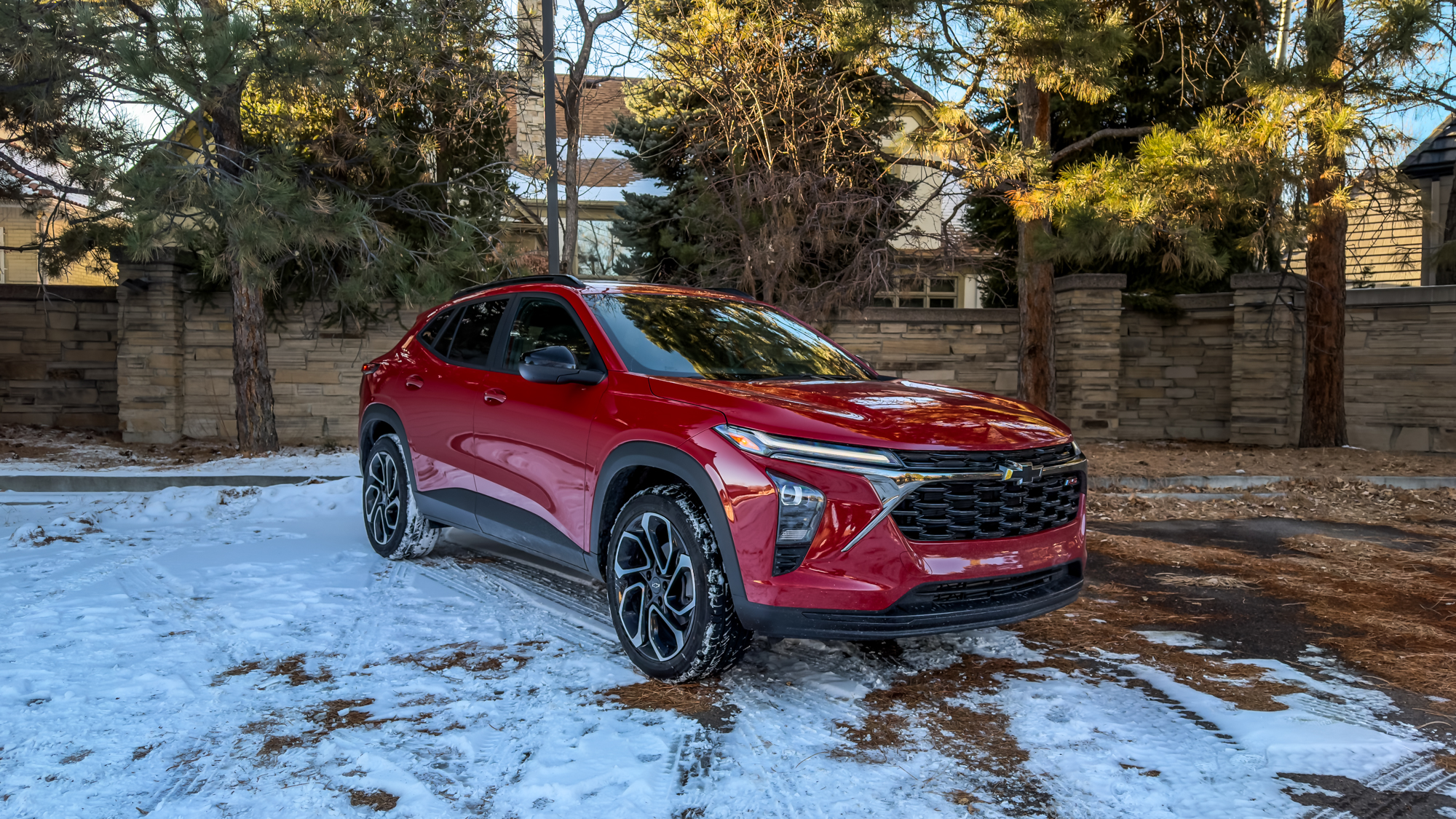
Americans replace their cars around every eight years or so, with that figure fluctuating somewhat depending on variables like the economy and who conducted the poll. Regardless, most aren’t buying brand new cars either. One S&P Global study found the average age of cars and trucks in operation in the US is 12.5 years. A lot’s changed in that time, and if you haven’t been in a new car in a long time, you might be surprised to learn that many, like this Chevrolet Trax, pack in a shocking amount of value for their comparatively low price tag.
Pricing: new cars deliver more

Chase Bierenkoven

Chase Bierenkoven
On that note, it’s worth whipping out the Bureau of Labor Statistics inflation calculator. Crunch some numbers, and you’ll be shocked at how much a value something like the Trax is compared to ten or twenty years ago. Take a 2000 RAV4. Offered with rear-wheel drive, the OG crossover SUV made do with less for more money than a modern contemporary like the Trax. The RAV costs an inflation-adjusted $24,965.
It’s about the same money as the Trax, which starts at around $23,000 (the one you see here is closer to $28K). But the Trax is safer, quieter, and more refined in every metric, to say nothing of the improvements in fuel economy and performance over something even a decade old. Put simply, it’s a heck of a value proposition. The problem is, at least for the Trax, other automakers can pull the same trick.
How the Trax stacks up

Chase Bierenkoven

Chase Bierenkoven
Chevy occupies the bottom end of the cheap crossover segment. We’ll get on to how and why it’s able to do that in a moment. For now, it’s worth addressing two competitors: the Mazda CX-30 and the Kia Seltos. You can find pricing for each below.
| Mazda CX-30 MSRP (incl. dest): | $27,470 |
| Kia Seltos MSRP (incl. dest): | $25,285 |
The Mazda offers a more premium take on the cheap crossover. You can read our full CX-30 road test here, but in short, it takes this idea to such an extreme that upper trim levels no longer feel so price-conscious. Mazda offers more powerful engines, all-wheel drive, and luxuries like a leather interior and premium sound system, which the Trax simply doesn’t have. Of course, it’s much more money.
Kia looks to compete more directly. The Seltos isn’t as exciting as the CX-30 with its turbocharged powertrain and typically Mazda driving dynamics, but it is efficient, affordable, and does so while offering a better tech experience than the Trax. More than that, the Seltos also offers all-wheel drive when paired with its larger engine, and more cargo capacity than the Trax and the Mazda. Price is the Trax’s biggest argument, and most trims will undercut comparable ones.
The tradeoff in the Trax

Chase Bierenkoven
Cut price, and you have to cut content. It’s basic economics, and the Trax is a near-perfect example. Its upper trims, like this 2RS model, get all the goodies, but at a cost. Coming in north of $28,000, our test car has niceties like remote start, the larger screen option, and heated seats, including a heated steering wheel. These are a veneer over what you’re giving up in exchange for the price: refinement.
Be it the interior materials used, the sound of the engine, the feel of the transmission, or the quality of the audio system, the Trax hits its price point by making do with less. This isn’t a derision of the small SUV. It’s a reality that most people (potentially yourself included) don’t care about any of these points. A cheap car is a cheap car. It’ll be used, abused, and depreciated before long. Lease a Trax, and it’s cheap – probably under $500 a month once you factor in some car insurance. Pain points like the Trax’s cheaper interior and its limited standard features fade somewhat given a few of its advantages.
The argument for the Trax (and the cheap car)

Chase Bierenkoven

Chase Bierenkoven

Chase Bierenkoven
Those advantages do center largely around pricing, but the Trax offers a few tangible items, too. For one, its included remote start feature (also standard on LT trims) is a luxury, and the footprint of the SUV makes it a seriously practical car. The rear seats are large, wide, and flat. Everyone, including pets, will have plenty of room and little to complain about. The story is the same behind those seats, with more cargo space than a CX-30 (though not as much as a Seltos). The Trax also rides very nicely, given its price point. While some road noise seeps through, the overall experience isn’t compromised.
The Trax feels built for the commute. Its tiny 1.2-liter engine makes only 137 horsepower, but it’s got enough pep to feel quick off the lights. It feels a little more lively than the Seltos, though it makes less power, largely due to its handling. More than anything, though, the Trax is a price-driven decision for buyers to make. Evaluated on that standard, the Trax excels against rivals both new and old.
About the author

Chase Bierenkoven
Senior Editor, Autoblog