
Why You’re Paying More So New Car Prices Stay Low
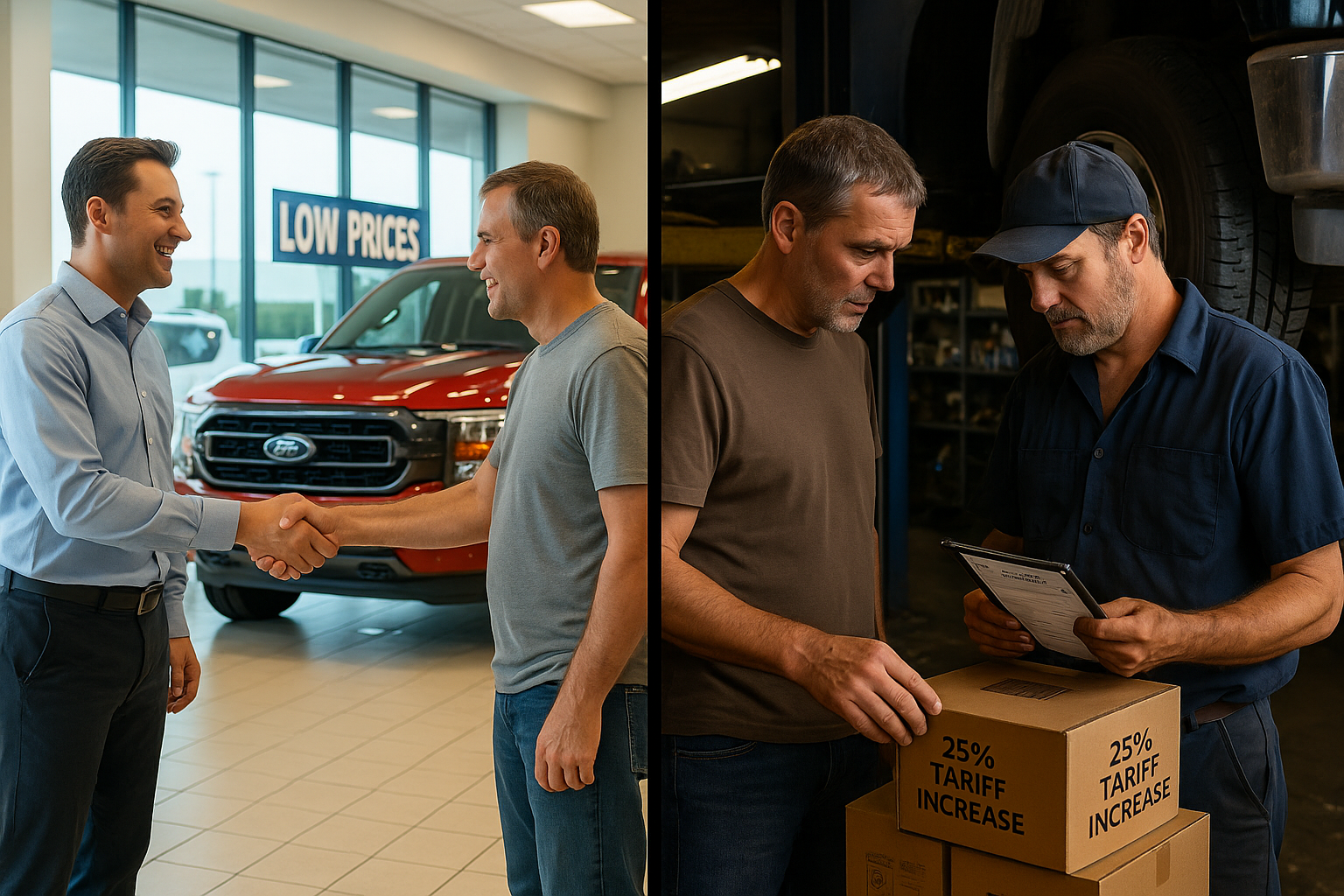
Two identical Trump tariffs landed this spring: 25% on imported new cars and the same 25% on imported parts. Automakers chose to swallow billions in losses to keep new-car sticker prices steady and shoppers walking into showrooms. Independent repair shops had no cushion, so they passed those same tariffs straight to you. That’s the scam. Working- and middle-class drivers keeping older cars alive are funding the volume game for Detroit and its rivals every time a service advisor prints an estimate.

Cadillac
Same Tariff, Different Results: New Cars vs. Repairs
General Motors recorded a $1.1 billion tariff hit in Q2 2025. Ford chalked up roughly $800 million for the quarter and warned the full-year bite could reach about $3 billion. Those aren’t random write-downs; they’re deliberate. Hold MSRP, smooth incentives, protect share. The pain lives on the income statement, not on the window sticker. Meanwhile, the parts side has zero room to absorb a 25% tax on sensors, lighting modules, turbos, hybrid components, and crash parts. The bill lands on your card.
Repair Costs Jumped 15%—Here’s Why
Repair prices jumped hard—about 15% year over year—with a brutal 5% spike in August alone, according to the Cost of Car Ownership Index. That’s not just “higher parts.” It’s higher shipping, longer backorders, and more labor time wrestling with tariff-strained supply lines. If you drive a paid-off Camry, Civic, F-150, or Equinox past 150,000 miles, you live in the repair economy, not the showroom economy. You don’t get subvented lease rates. You get line items that balloon because a control module crossed a border.

The Two-Tier Market: Who Absorbs Tariffs and Who Doesn’t
Call it what it is: a two-tier market built on one tariff. New-car buyers see calm pricing because carmakers eat the cost to keep throughput high. Owners who fix instead of finance get hammered at the counter. The policy didn’t change between the front door and the service bay. The power did. Automakers can play defense with scale and capital. Small repair businesses can’t. You make up the difference.
What Smart Owners Can Do Now
Get two prices: one for original parts (OE) and one for good aftermarket parts. Ask if there’s a North American-made option that’s known to be reliable. If insurance is involved, ask where the parts come from and when they’ll arrive, because delays cost money. For safety stuff like driver-assist sensors and modern headlight units, plan ahead and get a couple of quotes. If the repair on an older car starts to cost close to replacing the car, do the full math on total cost to own, not just the monthly payment.
What This Really Means
Dealers keep new-car prices calm because the repair shop passes the pain to you. That’s not a fair market; it’s your money covering their market retention strategy.
About the author

Brian Iselin
Senior Editor, Autoblog