
Betting on Imports
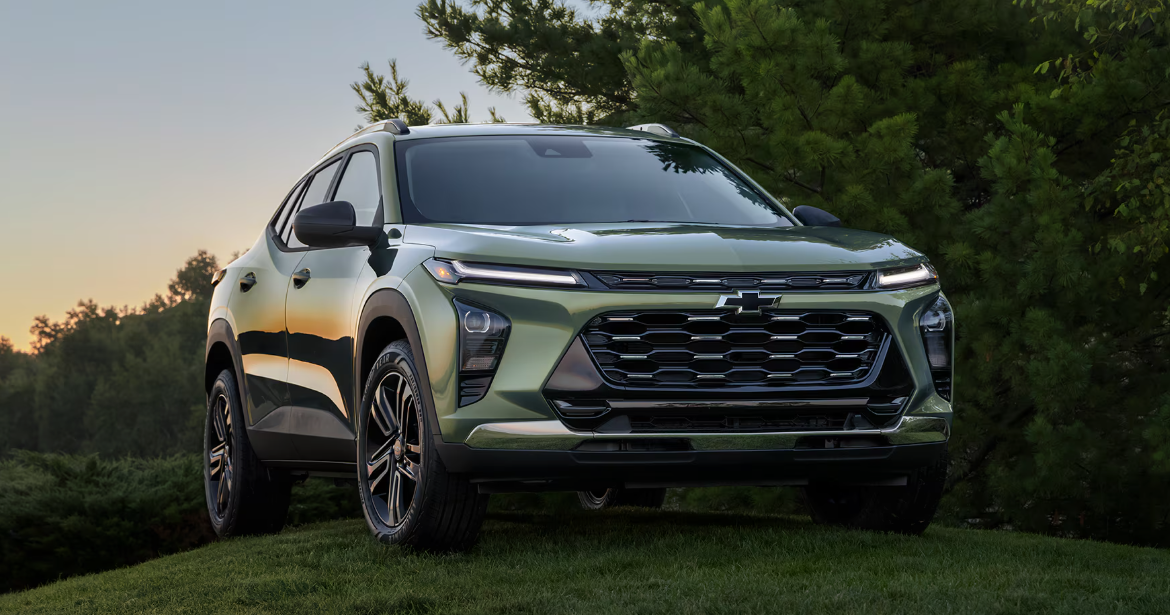
While automakers like Audi that rely on imports to the U.S. face headwinds, General Motors appears to be leaning the other way with the Trax. Strong demand in the U.S. is prompting GM to ramp up production in South Korea to the full capacity of 500,000 vehicles to increase imports.
According to a report by Automotive News, tariffs on Korean-made vehicles currently stand at 15 percent and could rise to as much as 25 percent. Despite that uncertainty, GM remains confident in boosting production of the Trax, which posted its best sales year in 2025 with 206,339 units sold – a 2.8 percent increase from the previous year.

Chase Bierenkoven
Built for the Everyday
The Trax is Chevrolet’s smallest crossover in the lineup, positioned below the Trailblazer and the Equinox. It serves as the brand’s answer to rivals such as the Hyundai Venue, Honda HR-V, and Toyota Corolla Cross, emphasizing affordability with a starting price of $21,700 for the 2026 model year, excluding destination fees. Power comes from a 1.2-liter turbocharged three-cylinder engine producing only 137 horsepower, which may sound modest, but the vehicle boasts an EPA-rated combined fuel economy of 30 mpg.

In addition to the Trax, GM plans to import more models produced in South Korea, including the Chevrolet Trailblazer, as well as the Buick Encore GX and Envista. Last year, the Trax and Trailblazer reached export volumes of 296,655 and 150,561 units, respectively. However, unlike the Trax, Trailblazer sales in 2025 declined by 2.9 percent to 101,363 vehicles in the U.S.

Chase Bierenkoven
Scaling With Purpose
Nevertheless, raising annual production to 500,000 units would reportedly reinforce GM’s strategy of using South Korea as a low-cost export base to North America, despite tariff pressures. It would also help ease concerns that the automaker might scale back its Asian operations to navigate trade-related challenges.
“We aim to operate our plants at full capacity to meet strong global demand for vehicles produced in Korea,” a GM spokesperson said.
This presents a positive outlook, particularly as demand in South Korea has increasingly favored domestic brands such as Hyundai, Kia, and Genesis. In the U.S., Hyundai and Kia also posted strong sales in 2025. Like GM, Hyundai still relies on imports subject to tariffs despite operating production plants stateside.

Chevrolet

Chase Bierenkoven

Chase Bierenkoven
About the author

Rex Sanchez
News Editor