
Democratizing horsepower is a controversial subject.
If there is a modern day vehicle that could be described as a vehicle that democratizes power, it would be something like the Dodge Challenger and Charger Hellcats. Between 2015 and 2023, Dodge shoved a monstrous supercharged 6.2-liter HEMI V8 into their muscle cars, giving them supercar beating numbers of 707 horsepower and 650 lb-ft of torque. Today, the Hellcat has gained a near-mythic level of admiration and internet notoriety, in part due to its accessible nature and its desirability among auto thieves that has continually persisted to this day.
But while the Hellcats are the modern-day standard for accessible high performance, the discourse pales in comparison to the controversy around a car from decades ago that had a similar impact. Decades before Stellantis unleashed a metric ton of horsepower to attract people to the brotherhood of muscle, GM launched a four-door that sparked panic among the powers that be.
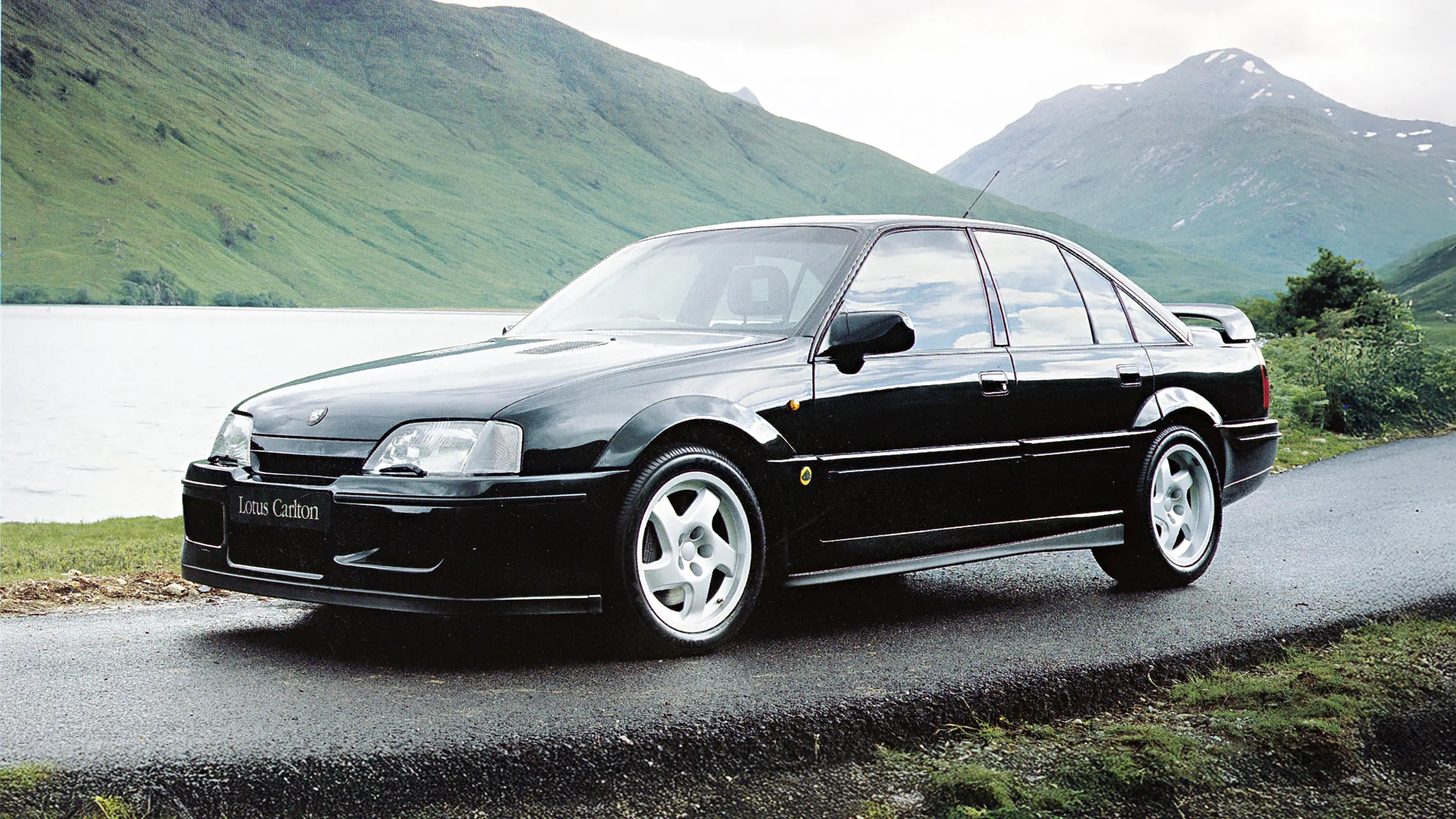
The Vauxhall Lotus Carlton wasn’t just fast, it was so fast that British politicians wanted it banned, the establishment media launched smear campaigns against it, and a brazen six-week crime spree confirmed everyone’s worst fears about Britain’s most wanted car.

Vauxhall

Vauxhall
A wolf in a suit and tie.
In 1986, General Motors purchased a 91% stake in Lotus, the legendary British manufacturer famous for lightweight sports cars and the engineering philosophy “simplify, then add lightness.” Although today’s enthusiasts might think the coupling was weird, GM saw value in Lotus’s expertise, particularly their F1-bred work in handling dynamics and advanced materials.
‘We can use their engineering talent and expertise,” GM advanced engineering VP Robert Eaton, told The New York Times in a March 1986 interview. At the time, some of the top sellers at GM’s European division were sensible executive sedans, namely the Opel Omega in Germany and its British twin, the Vauxhall Carlton. Mike Kimberley, the then-boss at Lotus, pitched GM the idea of an updated successor to the Lotus Cortina; a spiced-up, hot version of the Ford sedan from the 60s.
Development of the Lotus Carlton/Omega followed in 1989, and the engineers at Camp ‘simplify and add lightness’ went crazy with it. Using the Carlton GSi 3000’s 24-valve, 3-liter inline-six as a jump-off point, Lotus bored out the cylinders to 3.6 liters, bolted on two Garrett T25 turbochargers, reworked the internals and fitted dual water-to-air intercoolers.

Vauxhall

Vauxhall
The result was 377 horsepower and 419 lb-ft of torque. To handle all that power, Lotus used the same six-speed stick that GM also used in the Corvette ZR-1, as well as a ZF limited-slip differential to keep the power up in the corners. In addition, Lotus reworked its suspension with uprated springs, dampers, and anti-roll bars to cope with all this new power; with some parts derived from the bigger Opel/Vauxhall Senator. In addition, the Lotus 4-door also got massive Portland Engineering disc brakes with four-piston AP calipers up front and two-piston calipers stopping the back wheels.
Lotus also gave the Omega and Calton a set of wider hips and 17-inch Ronal wheels wrapped in the same kind of Goodyear Eagle tires used in the Lotus Esprit. Completing the look were Lotus badging, a rear spoiler, a discreet ground effects package and a ventilated hood. While the car stood out, like the Model T, Lotus Carlton and Omegas could be had in just one color: the iconic dark shade of Imperial Green.

Vauxhall
Dirty Car? Shop Chemical Guys Specials: Up To 40% Off
Disclaimer: If you buy something via one of our links, we may earn a commission.

Chemical Guys Basic Wash and Wax Kit: 28% Off
Get a high foam wash with Mr. Pink, then wax your ride the easy way with Butter Wet Wax.

Chemical Guys Exterior Starter Kit: 33% Off
Upgrade your wash routine with the Clean Exterior Starter Kit.


Chemical Guys Streak Free Glass Cleaner: Just $9.99
Ammonia-free formula is safe for all window tints.
Civil and moral panic
Lotus made just 950 units, split between 286 right-hand-drive Lotus Carltons for the UK and 664 left-hand-drive Lotus Omegas for the continent. At £48,000, or about £120,208 (~$164,000), adjusted for inflation, it cost as much as a Porsche, but it served as an aspirational product for the British working class.
But what made the Lotus saloon garner headlines worthy of today’s clickbait environment was what all those capabilities translated to on paper. Basically, GM told the European supercar establishment to read the Lotus Carlton’s performance stats and weep. All its upgrades meant that the Lotus Carlton/Omega was capable of 0 to 60 mph in just 5.2 seconds all the way up to a dizzying top speed of nearly 176 mph. This made it the fastest production four-door in the world at the time, as it was faster to 60 than not just the BMW M5, but also the Ferrari Testarossa.
While this car lit up the eyes of enthusiasts, others were horrified by the idea that GM; the conglomerate behind ‘working-class brands’ like Vauxhall and Opel, were irresponsibly handing over the keys to what were pretty much race cars to anyone that had the bread. In an op-ed by Bob Murray, the then-editor of Autocar, the UK’s biggest automotive magazine, pleaded with Vauxhall to neuter it, saying that “Nobody buying this car could possibly argue he either needs or will be able to use a top whack which is claimed to be around 180 mph.”
In addition, the country’s tabloids effectively labeled the Lotus Carlton as public enemy number one. The Daily Mail and the Association of Chief Police Officers launched a campaign to have the green super-saloon banned from UK roads, with the latter calling it an “outrageous invitation to speed.”

Lotus
This issue regarding the super-saloon boogeyman even made it to high powers of government. On November 16, 1990, Members of Parliament talked about it in the House of Commons (the British equivalent of U.S. Congress). In a public debate regarding road safety, Tory MP Sir Anthony Grant questioned the need for a company like Vauxhall to sell such a car, stating that they’d “require the skill of Nigel Mansell to operate them safely.”
“There is unanimity between the two Front Benches that it is ludicrous that motor car manufacturers should be advertising cars that have maximum speeds of 140, 150 and 170 mph. Some of these products are cheap cars that can be purchased by those who are incapable of driving them safely,” he said. “It is absurd that such cars should be made available on a large scale because there is no place where they can be driven at the speeds of which they are capable. It is absurd also that they should be positively advertised as being a good thing.”
This was not a partisan issue. Cross-bench MP, the Lib Dem, Alex Carlile condemned the Carlton and its alleged top speed, adding “It should not be available for public purchase, even at the outrageous price of, I think, £45,000.”
40 RA and the six weeks of mayhem
But while Lotus’s critics argued about its top speed and worried about police inability to pursue such vehicles and the potential danger during high-speed chases, Lotus, nor GM bowed to the demands and media pressure. Though the Lotus Carlton and Omega were limited-production models, the Carlton suffered under the same wrath and reputation that other contemporary high-performance “civilian” models like the Ford Escort Cosworth had at the time as targets for theft, joyriding and other associated car crimes in the UK.
Following its earlier controversy, the Lotus Carlton exploded back onto the front pages of papers because of what happened to one unlucky owner. In the early hours of November 25, 1993, Richard Austin, the owner of a Lotus Carlton bearing the registration plate 40 RA woke to the sound of his car’s alarm, as he witnessed his pride-and-joy and family car get stolen out his driveway.
“I could see them fiddling with the car.” Austin explained to Classic & Sports Car. “You don’t really think in circumstances like that, you just react.” He ran downstairs shouting at the thieves, but one of the thieves decked him before he could do anything. Upon regaining consciousness, he saw the thieves drag his Carlton out the drive with a Ford Sierra Cosworth. He told his wife to call the police and chased them in her Renault Espace. He found the car thieves not far from the house, struggling to hotwire the Carlton, but the thieves’ Vauxhall Cavalier reversed and smashed the Espace, immobilizing it.
“I heard them get the Carlton going and off they went,” he recalled.

@influxmag via YouTube

@influxmag via YouTube
What followed was a crime spree that virtually vindicated every politician and concerned citizen who had called for the Lotus Carlton to be banned. Following the theft, the group used 40 RA in eleven ram raids across the West Midlands and Worcestershire, using the super-saloon in vehicular smash-and-grabs targeting convenience stores, gas stations, and liquor stores to steal cigarettes and alcohol worth approximately £20,000.
The ram-raiding gang consistently outran the police on motorways, escaping at up to 160mph. Their most brazen stick-up occurred on January 6, 1994, when they committed their eleventh attack by reversing the car into a newsagent across from a police station; taking advantage of the Lotus’s insane speed.

@influxmag via YouTube

@influxmag via YouTube
“The car is such an advanced piece of kit and we didn’t have the technology to handle it,” Brian Osborne, a former detective at Bromsgrove CID who worked the case, admitted. He added that most pursuits were abandoned quickly due to the gang’s reckless driving and safety concerns for the public. “We were hoping that, given all the media interest and the public’s awareness, this vehicle would be seen somewhere not committing an offence. That was naïve, I suppose; in reality it was probably hidden well away.”
The police eventually used a helicopter to find the gang and their car, which Osborne believes “spooked them.” The 40 RA was found abandoned in a canal on January 14, 1994, and despite eleven smash-and-grabs in six weeks, they were never caught. Richard Austin would temporarily replace his stolen Carlton with a Renault Twingo, but in 2022, nearly three decades after the theft, he decided to buy another Lotus Carlton, which bears the infamous 40 RA plate.

Lotus
The Outlaw That Changed Everything
Today, Lotus Carltons and Omegas are collector items, due in part to its notoriety and the fact that it represented a brief, glorious moment when a major manufacturer built something absolutely mental without overthinking the consequences.
The calls to ban the Lotus Carlton seem almost quaint now. Today, there is a cornucopia of family cars that make big horsepower and are capable of speeds that can leave the Carlton for dead. The $80,000, 710-horsepower Dodge Durango Hellcat can seat seven, and is capable of 180 mph, while the 717-horsepower BMW M5 can also be had in a wagon. Even EVs are capable of insane power: the outgoing. 1,020-horsepower Tesla Model S Plaid is capable of 0-60 in a claimed 1.9-seconds.
However, there is a first time for everything, and the Lotus Carlton/Omega carries a type of outlaw mystique resulting from true notoriety. Call it the true OG of super-sedans.
About the author

James Ochoa
Senior Editor, Autoblog