

V6 vs inline 6, which is the superior layout? Most car fans have their favorite, but their loyalty usually stems from an emotional attachment to a particular make and model, rather than actual facts and figures.
To settle the V6 vs i6 matter once and for all we look into the differences between the two configurations, their pros and cons, as well as what layout manufacturers currently prefer.
The V6 Engine in Detail

Nissan
The V6 engine has been around since 1950, when European automaker Lancia first introduced it on its Aurelia sedan. This makes the configuration relatively new in the automotive world, yet it rose to popularity very quickly, and by the 1990s was the default choice for many motor manufacturers.
The layout is essentially comprised of two banks of three cylinders each, usually angled 60 degrees away from each other. This makes for a very compact design, and has been a popular choice for many manufacturers over the years. A V6 is inherently unbalanced due to the odd cylinder count and firing intervals at each bank, this requires the use of balancer shafts to smooth things out. It also usually uses two cylinder heads, aside from Volkswagen’s VR6 which is actually a hybrid between a V6 and an inline-six.
Some V6 engines have a 90-degree angle, usually because they are based on a V8 design to save on development costs. This necessitates additional balancing, and the use of split-pin crankshafts to further reduce vibrations. Performance cars like the Alfa Romeo Giulia Quadrifoglio use this specific layout to great effect.

McLaren
A 120-degree V6 is a far rarer layout, and generally limited to exotic supercars like the McLaren Artura and Ferrari 296. Benefits include a lower center of gravity, and the ability to place the turbos inside the V (called a hot vee design) while still leaving space for adequate cooling. However, its increased width and balancing issues make it less suitable for mass-production applications.
Whatever the angle of the V, the primary benefit of a V6 is its compact design. This allows it to be fitted transversely in an engine bay making it ideal for front-wheel drive applications. The rise of FWD in the ’70s and ’80s aided the adoption of V6 engines, and many manufacturers chose this route for their more powerful models.
The Inline-Six – The Original Choice
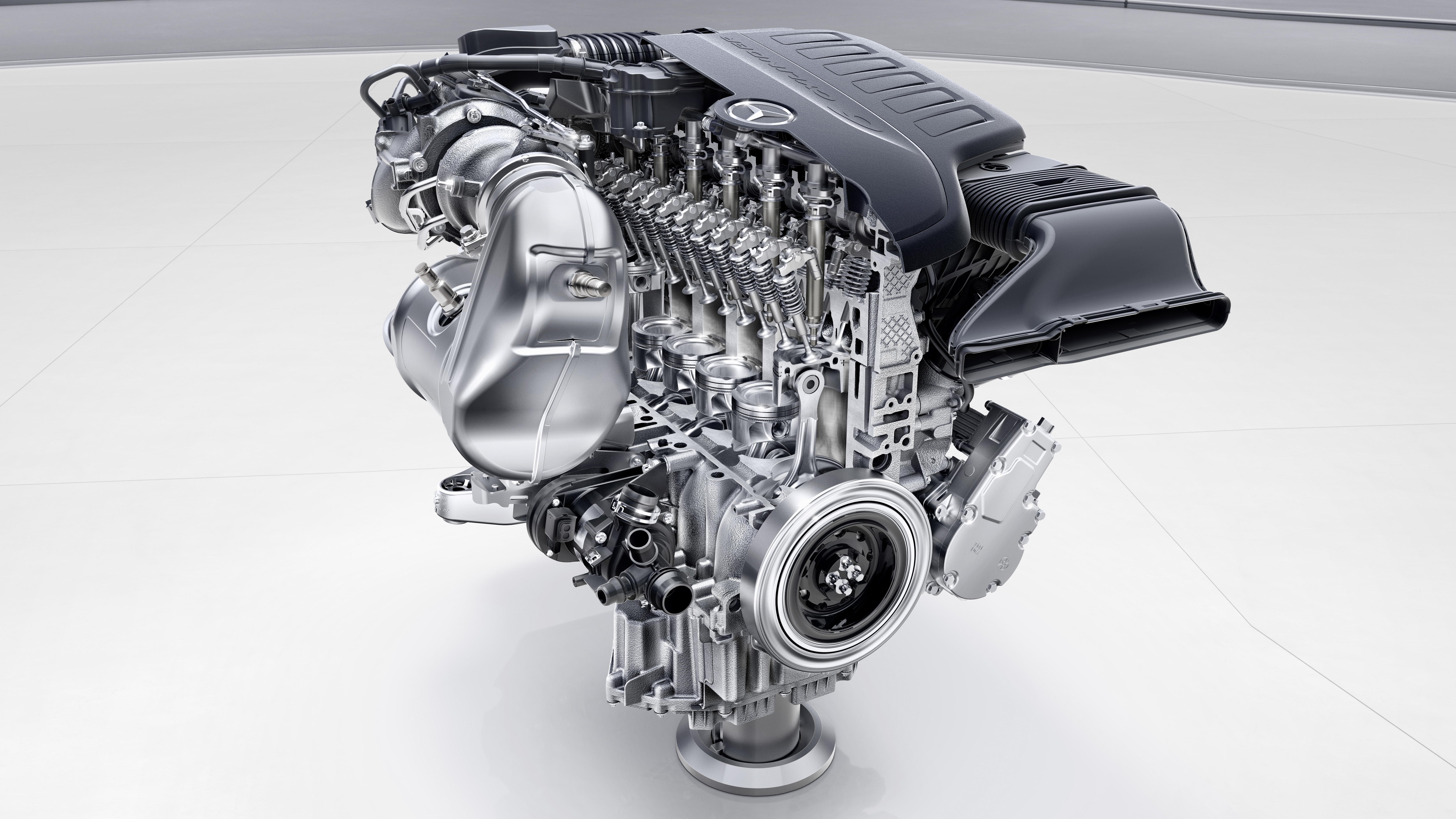
Mercedes-Benz
First used by automaker Spyker in 1903, the inline-six engine was adopted by most major manufacturers soon after. While BMW is most associated with this layout these days, it only introduced its first automotive inline-six engine in 1933.
The allure of an inline-six engine wasn’t hard to see, offering more prestige and the potential for more power than an inline-four, it was also smoother, lighter and cheaper to manufacture than a V8.
An inline-six engine is essentially six cylinders arranged in a line on a common crankshaft and sharing one cylinder head. The design is simpler than a V6 and since both the primary and secondary forces are canceled out, it is perfectly balanced. That means no need for balancer shafts. The engine’s smoothness also allows for a longer stroke which promotes low-rev torque.

However, the inline layout makes it much longer, and it’s usually only suitable for longitudinal placement. There have been a few transverse inline-six engines, most notably from Volvo, but the vast majority are longitudinal, which means they are best suited to rear-wheel drive layouts. This packaging and hence drivetrain limitation made the inline-six a no-go in compact FWD vehicles, but it is a great choice for larger RWD vehicles and sports cars.
V6 vs Inline 6 – which is best?
| V6 Pros | Inline-6 Pros |
| Compact layout | Perfectly balanced |
| Can be fitted transversely for FWD applications | Mechanically simpler |
| More efficient | |
| V6 Cons | Inline-6 Cons |
| Inherently unbalanced – requires balancer shafts | Longer length makes it suitable mostly for longitudinal fitment only – no FWD |
| More complex design | Higher center of gravity than V6 |
The Final Analysis

Stellantis
While both layout have their benefits, and there are great examples of both V6 and inline-six engines out there, from a technical standpoint, the inline-six is the superior engine. BMW has only every used this layout, and in recent years other manufacturers like Mazda and Stellantis have started adopting this layout as well. Mercedes moved to V6 engines in the late ’90s, but has been transitioning back to the inline-six since 2017.
With many manufacturers choosing turbocharged inline-fours to replace their aging V6s, the inline-six seems to have become the replacement for older V8s, just take a look at the the latest 540-hp Dodge Charger Sixpack. These engines are still capable of producing serious power, but with less mechanical complexity and better economy. The inline-six has quietly become the default choice for automakers still transitioning to our inevitable EV-powered future.
About the author

John Tallodi
Senior Editor