
Is bigger always better?
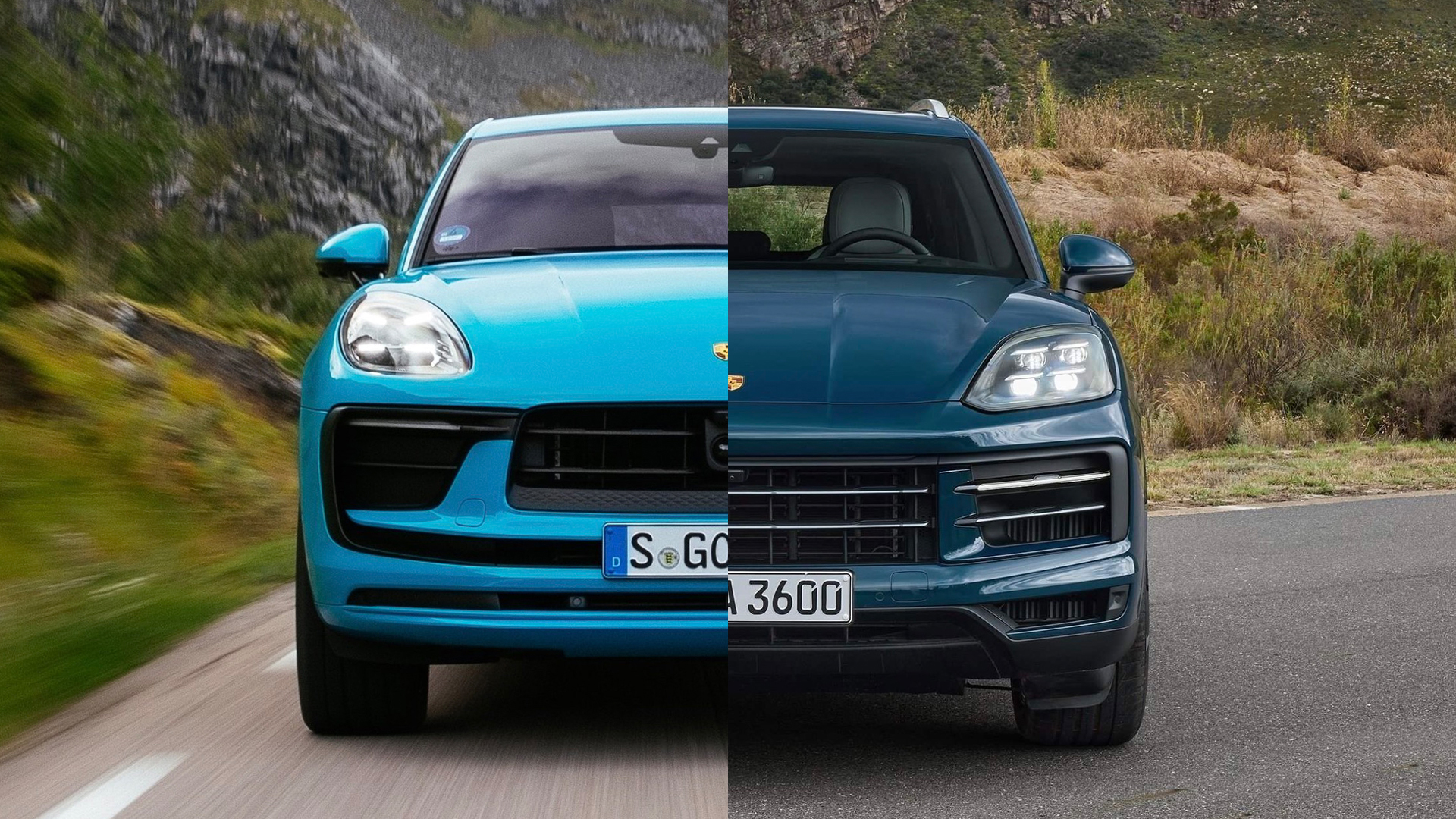
The Porsche Macan and Cayenne are two of the best-performing SUVs on the market. They aren’t necessarily the largest or most luxurious, but they set benchmarks for driving pleasure in a high-riding SUV. Both nameplates have now spawned all-electric versions—most recently the new Cayenne Electric—but for the purposes of this comparison, we’ll focus on the standard Macan and Cayenne, should you find yourself unable to decide between these two vehicles. Here are five differences between them.
1. Porsche Macan Vs. Cayenne: Size and Weight

Porsche

Porsche

Porsche

Porsche
The Porsche Macan slots into the compact segment, while the Cayenne is a midsize model. This is obvious when the two vehicles are parked alongside each other—the Cayenne is visibly taller and longer than its sibling. The Macan vs. Cayenne size comparison is also reflected in significantly different curb weights.
| Porsche Macan Vs. Porsche Cayenne Specs | ||
| Model | Porsche Macan | Porsche Cayenne |
| Length | 186.1 inches | 194.1 inches |
| Width (without mirrors) | 75.7 inches | 78.1 inches |
| Height | 63.8 inches | 66.9 inches |
| Wheelbase | 110.5 inches | 114 inches |
| Curb weight (base models) | 4,149 lbs | 4,678 lbs |
While the Cayenne’s larger size contributes to it feeling more luxurious and spacious, the base Macan’s lighter weight (by 529 lbs) makes it more suitable for city driving. It also feels more agile on a twisty road, although both SUVs exhibit excellent handling characteristics for tall vehicles. In hybrid form, the Cayenne is a bit of a tank, as it can weigh as much as 5,664 lbs.
2. Cayenne Is Available In Two Body Styles

Porsche

Porsche

Porsche
The gas-powered Porsche Macan is available in just one body style. It’s a shape that’s been around for a while, but it’s still a sporty-looking vehicle. From some angles, it’s almost more of a raised hatchback than an SUV. There are hints of the 911 in the lights, although the Macan is a much beefier vehicle than that sleek sports car.
The Cayenne, meanwhile, is available as both a traditional SUV and a sexier coupe-SUV, known as the Cayenne Coupe. The standard SUV looks sharp after its most recent facelift, but the Cayenne Coupe’s sloping roofline certainly stands out.
All three models—Macan, Cayenne, and Cayenne Coupe—are clearly from the same family, with styling cues that mirror each other. This isn’t a bad thing if you can’t make the stretch to the Cayenne, as the Macan has a similar premium look as its pricier sibling.
As with all Porsches, these SUVs can be endlessly customized, but options are more expensive than on other German cars.
3. Cayenne Has Hybrids and V8s

Porsche

Porsche
Looking at the Porsche Macan vs Porsche Cayenne’s powertrain specs reveal many fundamental differences.
The Macan starts off with a 2.0-liter turbocharged four-cylinder engine producing 261 horsepower, making it Porsche’s slowest new car—no Cayenne has a four-cylinder mill. A larger 2.9-liter six-cylinder turbo is found in the Macan S, which makes 375 hp. But the quickest Macan of all is the GTS, which gets a 2.9-liter turbo six-pot with 434 hp, allowing for a 0-60 time of as little as 4.1 seconds.
The Cayenne starts off with six-cylinder power, in this case a 3.0-liter turbo mill with 348 hp. Unlike the Macan, you can also have it with a plug-in hybrid, starting with the E-Hybrid’s 463 hp combined. The Cayenne S is the first V8 model; its 4.0-liter turbo V8 makes 468 hp. From there, power steadily increases to 493 hp in the Cayenne GTS and 512 hp in the Cayenne S E-Hybrid.

Porsche
For the ultimate in power and performance, the Cayenne is offered in Turbo E-Hybrid guise—there is no equivalent Macan. This Cayenne’s V8 and electric motor combine for 729 hp, allowing for a 3.5-second 0-60 time. The quickest Cayenne of all is the Cayenne Turbo GT, a coupe-exclusive variant with 650 hp from its V8 and a 3.1-second 0-60 time.
Across the respective ranges, the Cayenne is simply faster and more powerful.
4. Macan Has Fewer High-End Features

Porsche

Porsche

Porsche

Porsche
The Porsche Cayenne isn’t only quicker, but it’s got a more luxurious cabin with extra amenities. In standard form, the Cayenne comes with additions like a better 10-speaker sound system (eight speakers in the Macan), a 3D surround-view monitor instead of the more basic rearview system, and more advanced Matrix Design LED headlights. You can add ventilated back seats and massaging front seats to the base Cayenne, but not the Macan. Lane change assist is standard in the Cayenne, but not in the Macan, and there’s a better Burmester sound system available for the Cayenne.
Whether in standard form or fully loaded, the Cayenne has more to offer than the simpler Macan.
5. Cayenne Is Much Pricier

Porsche
All the Cayenne’s attributes come at a much higher price point, though. The Cayenne starts at $89,900 for the base model, while the top Cayenne Turbo E-Hybrid costs a jaw-dropping $164,500. The wild Cayenne Turbo GT, the most expensive Cayenne Coupe, goes for $214,800.
The Macan isn’t affordable next to its natural rivals, but it’s way less than the Cayenne with a starting MSRP of $65,400. At most, you’ll pay $94,200 for the Macan GTS; the Cayenne GTS is $132,400, so that’s almost $40k more for the comparable Cayenne trim.
Final Thoughts
If you’ve committed to the Porsche SUV family, the Macan and Cayenne both deliver the sort of driving enjoyment not typical of SUVs. If your lifestyle simply isn’t compatible with the limitations of sports cars like the Boxster or 911, these SUVs are the next best thing.
The Cayenne is a much better overall package than the Macan. It feels more upmarket, has stronger powertrains, and provides better passenger/cargo space. But it’s a lot pricier, so we wouldn’t blame you if you saved $20k or more on a Macan.
The downside of both Porsches is that rival SUVs from Audi, BMW, and Mercedes-Benz offer a lot more for less money. If the gravitas of the Porsche badge doesn’t mean that much to you, we’d recommend testing another SUV before committing to the pricey Porsches.
About the author

Karl Furlong
Senior Editor, Autoblog