
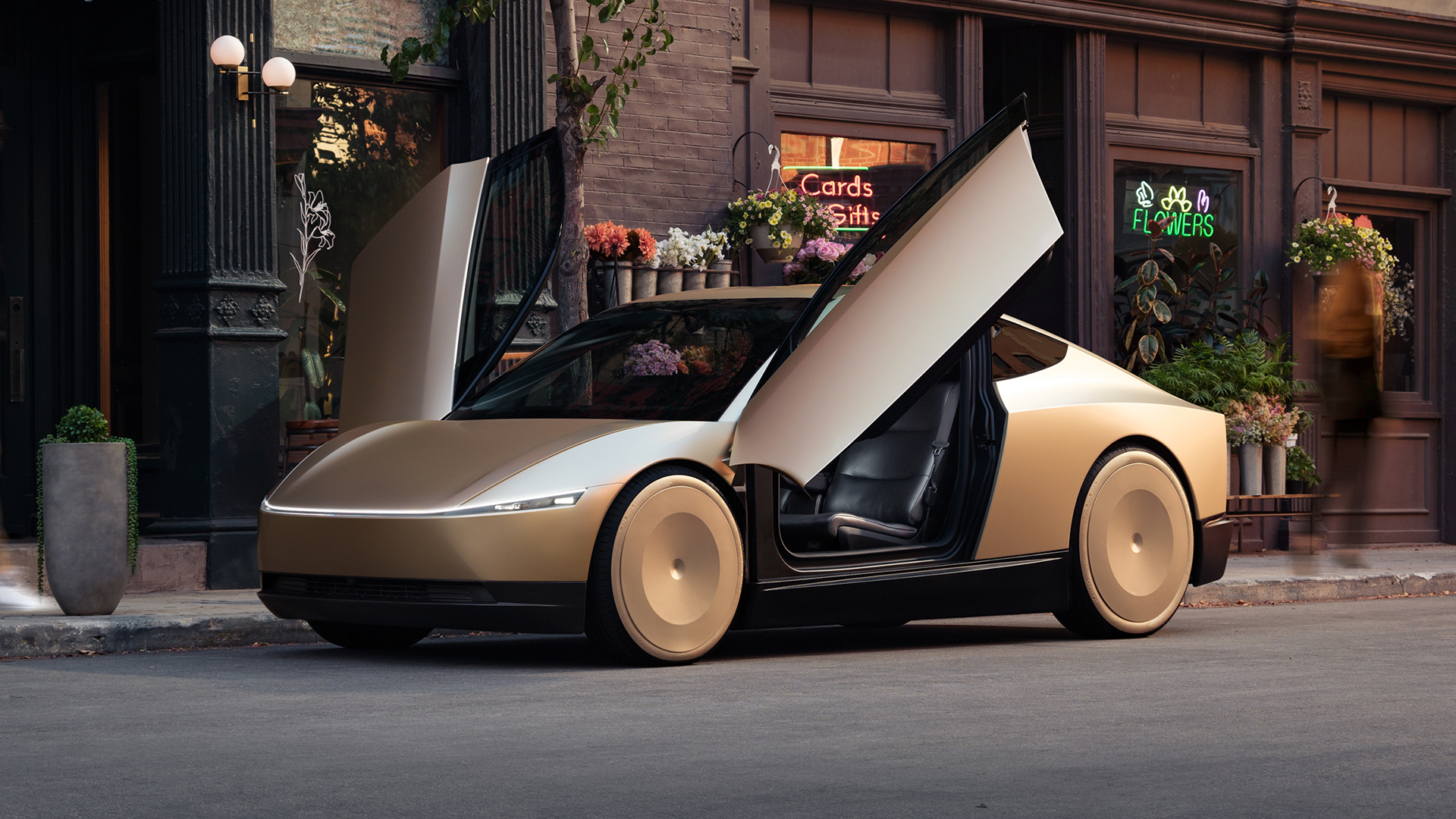
Tesla’s first Cybercab has officially rolled off the production line in Texas, a milestone that Elon Musk shared enthusiastically on social media platform X. A two-passenger, self-driving electric vehicle with no steering wheel or pedals, the Cybercab is a marked step up from the company’s robotaxi fleet. The Model Y robotaxi still requires a human “safety monitor” in most cases, but the Cybercab has no means of it being driven manually at all—and that’s why major questions remain, as Tesla’s current level of autonomy appears unprepared for a vehicle that relies on the software exclusively.
$30,000 Price Confirmed, Too
Coinciding with the first production Cybercab, Musk appeared to confirm a starting price of $30,000 for the fully autonomous vehicle in a response to Dillon Loomis, Tesla enthusiast and content creator. That supports Tesla’s desire for the Cybercab to be one of the most affordable vehicles to operate; Musk previously said he wants to hit a figure of $0.20 per mile for the vehicle, which includes everything from charging to insurance and depreciation.
Ride-hailing companies like Lyft and Uber are expected to be the primary initial customers for the Cybercab, but the goal is also for private owners to buy them. In theory, it would be a game-changer for people who can’t drive, whether out of choice or if they have a disability.
A peek inside the Cybercab shows nothing but two seats and a center touchscreen, as conventional driving controls aren’t needed at all.
Many Cybercab Challenges Await

Tesla

Tesla

Tesla
While getting the first production model built is an achievement, there remains much skepticism about the mass appeal of the Cybercab. For starters, Tesla may not even be able to use the Cybercab name due to a trademark dispute with a French beverage company. But that’s insignificant alongside the autonomous driving software the Cybercab will need.
Tesla’s Full Self-Driving (FSD) system in cars like the Model 3 and Model Y has made great strides in recent months, but it’s still a Level 2 system that requires human supervision—and nowhere near the Level 5 autonomy required of the Cybercab. Yes, Tesla does have a small fleet of self-driving robotaxis on the road, but these have mostly required a human’s supervision, too. Furthermore, there have been a worrying number of low-speed robotaxi crashes in Austin, Texas, even with a human present to supervise trips.
Finally, Musk said in January that the production rate of Cybercab will initially be “agonizingly slow,” given that it’s such a new concept within the Tesla lineup.
Our Take: Cybercab Exists, But True Autonomy Doesn’t

Tesla
Tesla seems to have gone about developing the Cybercab in a rather backwards fashion. Logically, it should have perfected autonomous driving before the Cybercab was produced, something it has yet to do. An unsupervised FSD system would have been a solid step in the right direction. Beyond that, Tesla would have ideally had such vehicles on the road for long enough to prove their safety and reliability. Once you remove physical driver controls, passengers are entirely at the mercy of properly functioning software.
Getting the software right and proving the Cybercab’s safety credentials must be Tesla’s priority right now. Until then, we can only be cautiously optimistic about the driverless vehicle.
About the author

Karl Furlong
Senior Editor, Autoblog